

The acoustic weak point
To open, a door needs gaps around it. Every gap is a path for sound. That's why the door often decides how private a glass room really feels:
- Perimeter seals close the gaps at the sides and top of the door leaf.
- A drop seal lowers automatically when the door closes, closing the gap at the floor.
- Without them, a high-performing wall effectively performs like the door.
The problem with cutting glass
Glass doors are usually made from toughened (tempered) glass, which is heat-treated for strength. Once toughened, it can't be cut or drilled. So on a typical glass door:
- Holes and notches for hinges, locks and handles are made before toughening, to exact positions.
- If a position changes on site, the glass has to be remade, and the programme waits.
- Edges and holes are where glass is most vulnerable to damage, so every cut-out adds a point of risk.
A door that keeps the glass whole
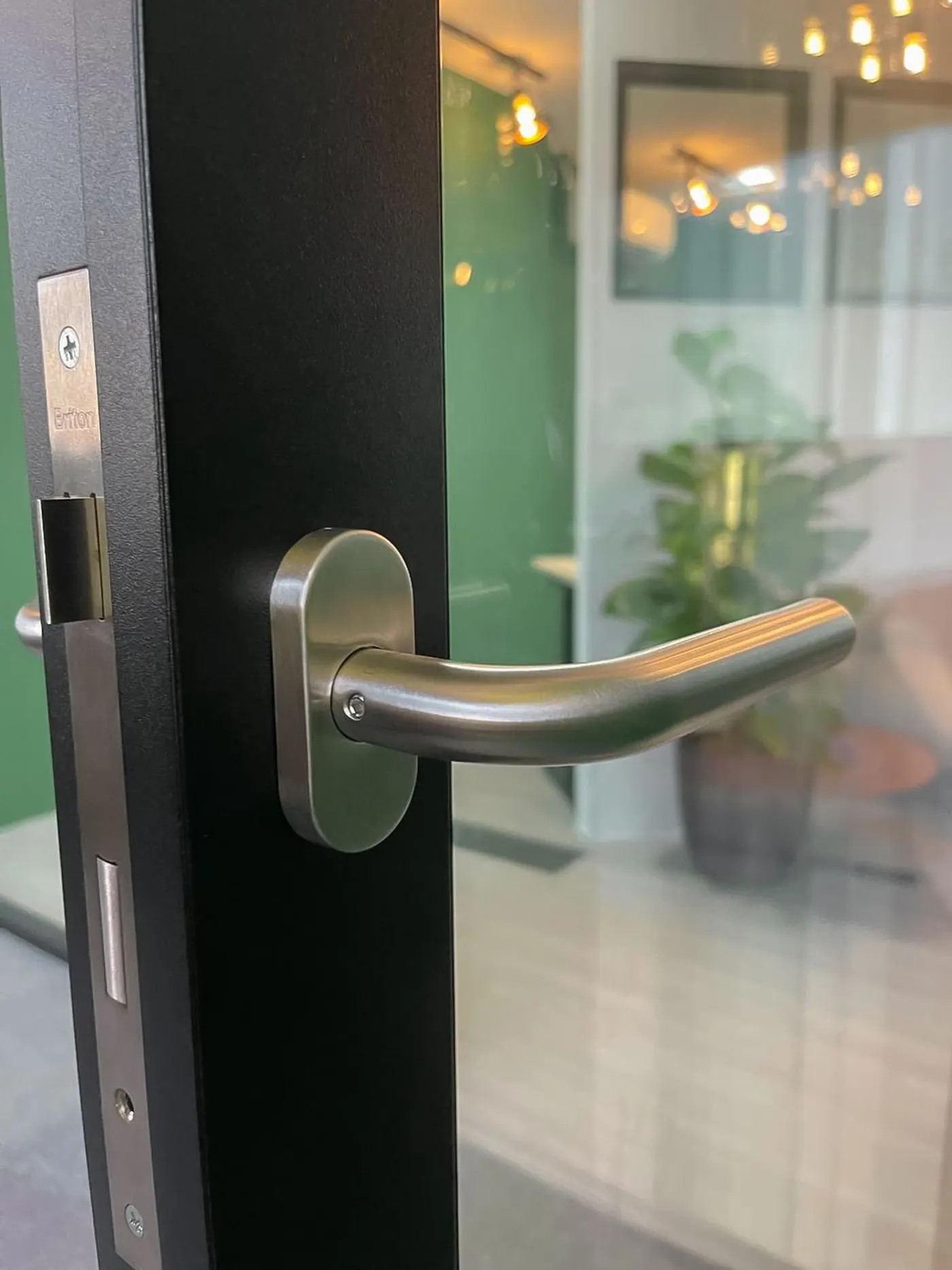
EPX's door panel was designed from our own experience working with glass: the glass needs no cut-out at all. The pane stays whole, installation is faster, and the risk of shattered glass is lower. It pairs with every EPX glazing system, single or double.
What to check when specifying glass doors
- Seals on all four sides, including a drop seal, if the room needs privacy.
- Hardware chosen early: handles, locks, closers and any access control, so nothing changes after the glass is ordered.
- A frame and door system designed together, so seals and hardware line up with the partition.
- Swing direction and clearances that suit how people move through the space.